The Koshas (They can change your life!)
I have wondered for many years why the Koshas aren’t in every class, taught to students in school and why more are not turning to this incredible system more often as it has been the tool I’ve turned to the most over the years. So I’m hoping to introduce (or re-introduce) this amazing philosophy to you so you can incorporate it into your life and feel for yourself just how amazing the Koshas are.
Koshas were first 'discovered' 2500-3000 years ago and found in the Taittiriya Upanishads, an ancient text from the 6th century B.C. It influenced not only the trajectory of Yoga but also many religions including Buddhism. The word Kosha translates in English to sheath, but with all Sanskrit words there are always more than one meaning and more than one way of interpreting it, I prefer bodies. For the sake of this article I will use sheaths and bodies interchangeably. The Koshas are layers covering the 'atman' the Self, our soul, our consciousness if you will. Each Kosha represents a dimension of consciousness in human form, encompassing physical, energetic, emotional, mental and spiritual levels of our beings. There are five bodies within this practice, from gross to subtle or subtle to gross depending on which way you like to look at it. You can use the image of bubshka dolls to picture this.
The five sheaths are:
Annamayakosha - 'Foodstuff' stealth, physical body
Pranamayakosha - ‘Energy' sheath
Manomayakosha - 'Mind stuff' sheath mental/emotional
Vijnanamayakosha - ‘Wisdom' sheath, awareness, intuition
Anandamayakosha - 'Bliss' sheath
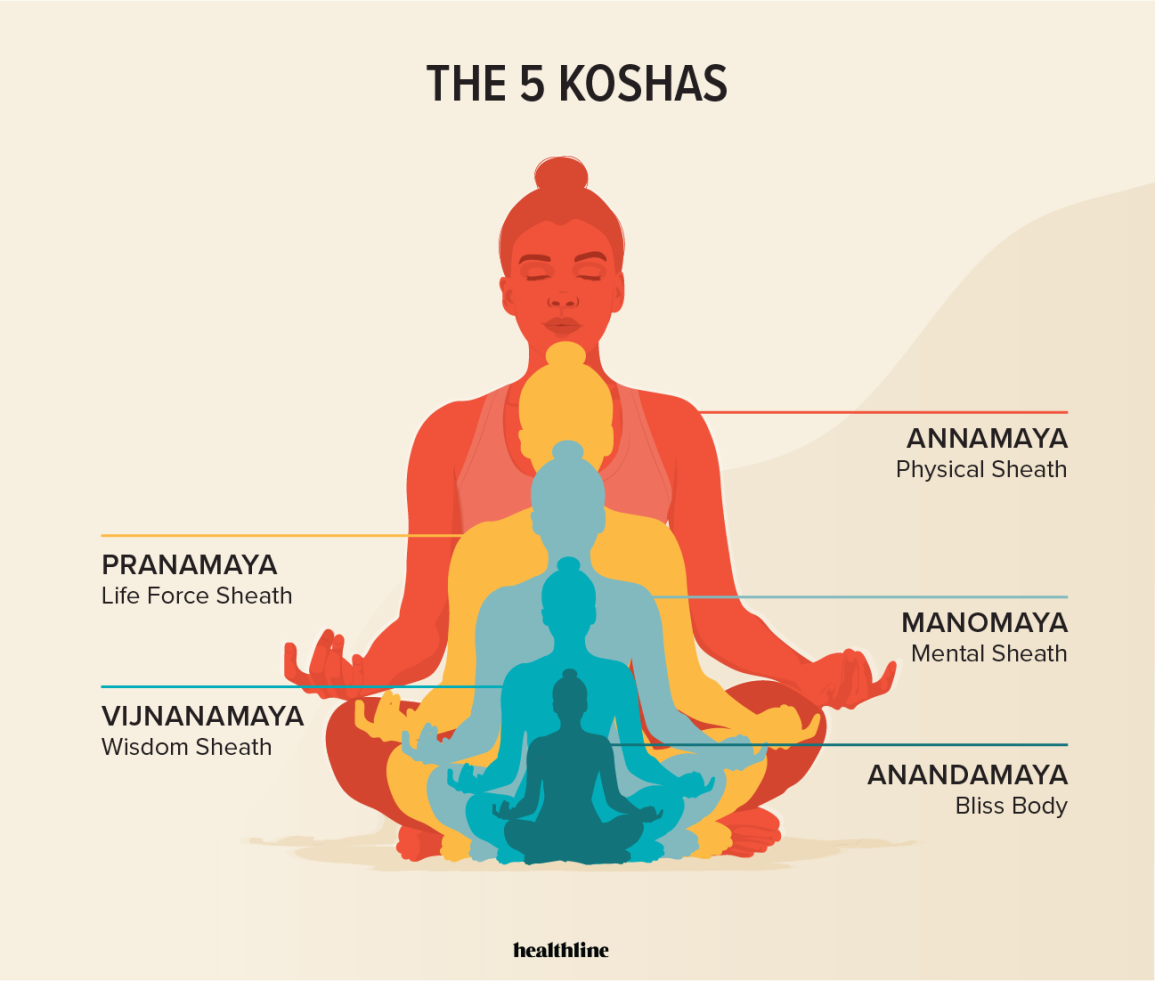
Annamayakosha: This sheath belongs to the most gross layer of our being, our physical body - skin, flesh, bones, organs, glands, hormones, genetic coding etc. This Kosha is concerned with how we move and the health and well-being of our physiology.
Pranamayakosha: This Kosha is our energy body, our vitality, the prana of our being. It is said to extend two to three inches beyond the body of the first Kosha (our physical body) and interpenetrates the whole organism. This energy is related to all biological process, it is what gives energy to the circulation of blood, the power to digest, the flow of breath.
Manomayakosha: this is often the layer where most of us live! This Kosha is related to all things thoughts and emotions. It governs the way we relate mentally and emotionally to the world around us and is how we create meaning of the world.
Vijnanamaykosha: Ever just have a hunch about something, or you're not sure how you know something, but you have a gut feeling? Well that belongs to this Kosha. Vijnana means the power of judgement or discernment without needing reason or even understanding. It is our intution and will.
Anandamayakosha: The bliss body, the most hidden part of ourselves. This Kosha is that state we sometimes enter, briefly albeit for most of us, where everything is sublime, connected, blissful. To reach this state we often need to ‘take care‘ of the aforementioned Koshas first. We can connect to this Kosha through either a favourite activity, through prayer or deep mediation.
What does Maya mean? Maya translates to illusion. Each sheath is an illusion, a covering of the ‘true’ self. Still beautiful and deeply human though.
How to incorporate this into your practice:
Option 1:
My favourite way is to use it in a meditation. It can be a quick 2 minute meditation or you could spend hours on just one of the bodies alone! I find myself turning to this practice when I feel out of sync, anxious, overwhelmed or disconnected. It’s starting from the most gross (physical/dense) body to the most subtle.
Firstly recognising the physical body, the limbs, torso, back, top of the skull, face . Letting all the muscles soften. Noticing what you notice, tightness, pain, tingling, lightness ect.
Next feeling into your energy body. Pranamayakosha. Your energy level, picking up on the space just above your skin, the flow within. This can take time, but always coming back to the reminder that this is a feeling practice, we are not trying to imitate each other, we are all having our own experience.
After that spend time objectively where we already spend a lot of time, in the mind. The Manomayakosha. This includes identifying thoughts as they come or have been showing up, and how you are feeling, where it resides in the body, the textures and from there disconnecting, letting them feel their way out.
Following up from there we feel into, Vijñānamayakosha. This sheath relates to our intuition, wisdom, the sense of deep knowing. We may stay here for a brief moment and other times we may linger. As the thoughts subside and a deeper more certain knowing arises.
And finally we enter the bliss body. Anandamayakosha. This is where all the bodies dissolve leaving you in pure harmony, connection and peace. Again this might be a brief moment, but it sure is wonderful and even just the knowing that it always there, beneath all the other bodies is a comforting thought.
Option 2:
The other way is to practice from subtle to gross. I personally find it quite difficult to journey straight to Vijnanamaykosha and Ananadamayakosha, but it can be useful when targeting an injury or to promote connection in your asana (physical) practice.
Option 3:
Oh hey you can also go rogue! Stuck in the Manomayakosha (the mental and emotional body) spend time there, letting it all be heard, felt, acknowledged and then letting go before melting into the annamayakosha.
While we live in this human body, it is the centre to connection. It our link to all of life. Enlivening the senses, softening to muscles, letting go of thoughts, strengthening our intuition and finding bliss here and now is the roadmap to union.